Adapting world models is subtler than success rate
Adapting a world model inside a closed loop is subtler than it looks.
A planner predicts, acts, observes, and replans. Adapt the model and you change every step of that loop, not one prediction. So “did the episode reach the goal?” is only part of the question. How it got there matters too.
Below, “adapted” means the world model is updated during the episode as the planner acts and observes. “Un-adapted” is the same model left alone. Each comparison uses the same seed, goal, and planning budget, so the only difference is whether the model adapts.
Success with a wild journey
On AdaJEPA’s PushObj task, an adapted run can keep reaching the goal while leading the pushed object along a far more convoluted path. In these two episodes the un-adapted model already succeeded, directly, so adaptation wasn’t needed. It still changed the journey, and no success metric flagged it. The direct path is the un-adapted one. Color is the adapted path.
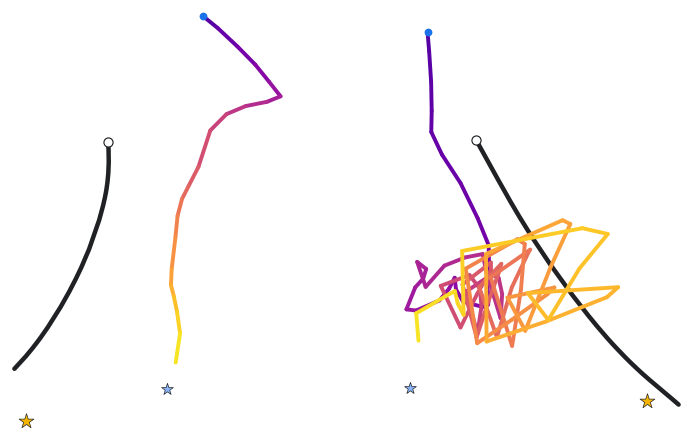
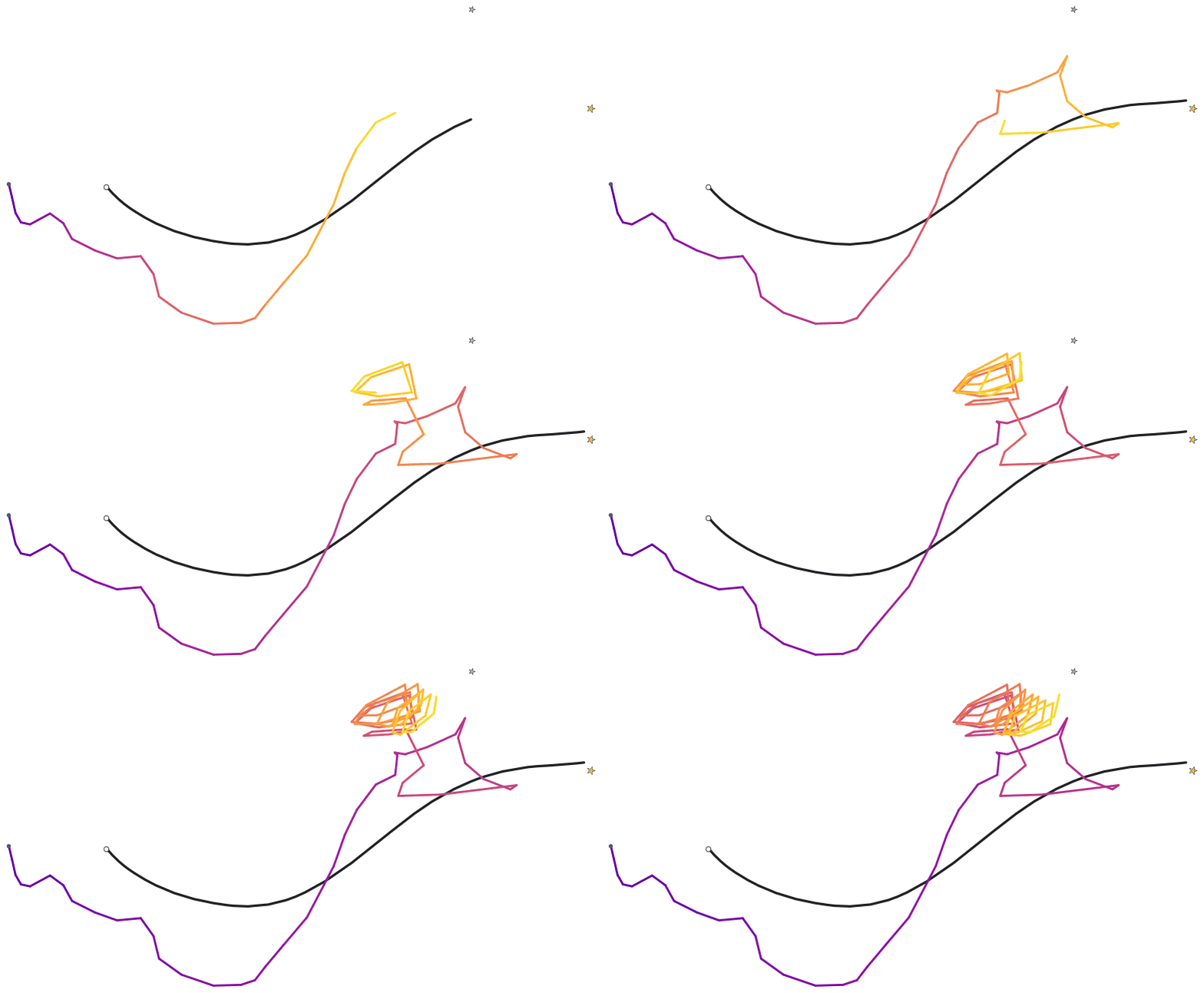
The second case is sharper. The adapted pusher reverses direction 29 times before reaching the goal. The un-adapted pusher gets there in a journey five times shorter. Both count as success, so a success metric never sees the 29 reversals. A long planning horizon makes this easy to miss: given enough steps, a meandering run still arrives.
What a success rate can’t tell you
These are illustrations, not a measured rate. They show what a success table can hide. Two things follow. Adaptation isn’t always needed, and when it isn’t, it can cost something the metric doesn’t score. And a higher success rate alone can’t establish that adaptation improved a latent world model.
So we also have to measure the journey. What second-order effects does adaptation cause, and are they acceptable where the model will be deployed? In physical systems, a path like this can mean wasted time, wear, or risk. Later notes get into what to adapt, and when, including why lower prediction error isn’t automatically the safer model.